


Chapman has recently begun installation of a 139 kW 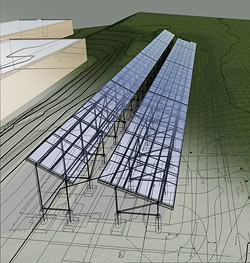 ground-mounted solar array northwest of Boston. The four ground mounted arrays are part of a larger 506 kW system for the office complex that also includes photovoltaic modules on the roof. When complete, the project will contain approximately 2,530 modules and will be one of the largest photovoltaic systems in Massachusetts.
Chapman coordinated the design of the custom steel frame that supports the PV modules. The design of the structural frame accommodates specific load and span criteria of the solar rail system as well as the modules themselves. Arrays of this size also create unique wind loading consideration that had to be accommodated in the design along with expansion and contraction criteria.
In addition to the steel framework, Chapman is coordinating the design and construction of an innovative foundation system engineered to minimize disruption to the site and virtually eliminate spoils. The displacement pile system allows all four arrays to be installed on site at their optimum tilt and orientation with minimal disruption to the site, building occupants, and neighbors.
The structural design of the project was completed using Autodesk’s Revit software, which allowed the project team to quickly evaluate the merits of early schematic designs and determine the preferred solution. Once the design was developed, the software facilitated the coordination and tight construction tolerances required between the foundation and structural frame. In addition, the virtual model helped all members of the team to visualize the final solution throughout the process.
The project is being built in conjunction with Alteris Renewables and is scheduled to be complete in June 2010.
published 05.14.2010